Ceiling TV Mounting: A Bold and Innovative Solution
When Ceiling Mounting Makes Sense
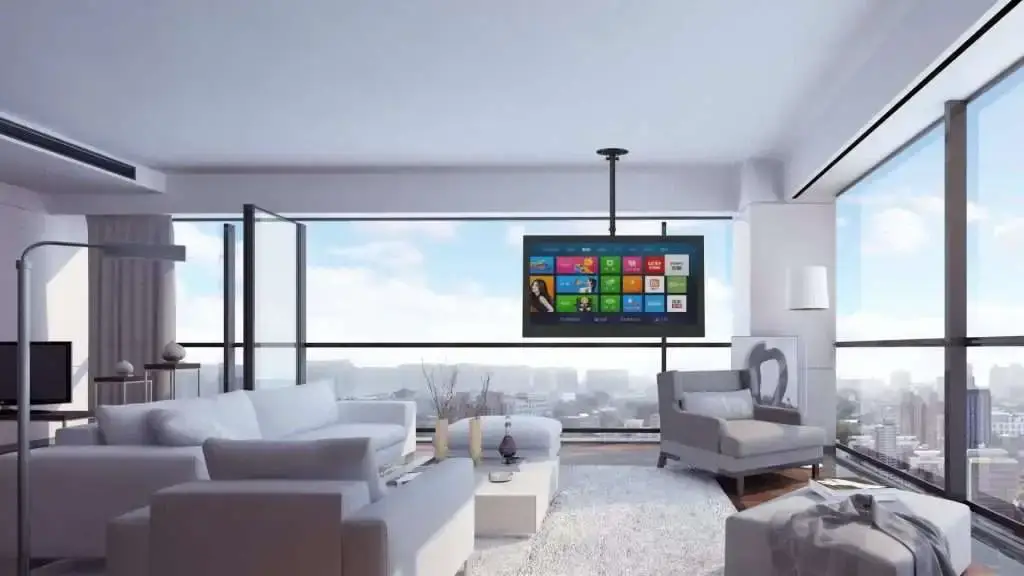
Ceiling mounting requires a careful weighing of the pros and cons, as it is far from the most standard solution for a residential home. However, sometimes such a setup becomes the most optimal choice for smart space organization, known as ergonomics. In Chicago — a city famous for its diverse architecture, from sleek high-rises to industrial lofts — this installation method is highly sought after.
In what cases is ceiling mounting most appropriate?
- Commercial Spaces: Bars, restaurants, fitness centers, and waiting areas. It is vital to elevate the screen above head level to ensure a clear line of sight from any point in the room and to protect the equipment from accidental damage.
- Bedrooms with Panoramic Windows: If an entire wall facing the bed is occupied by floor-to-ceiling windows, there is simply nowhere to hang a TV. A ceiling mount allows the screen to be “dropped” from above without obstructing the city view.
- Open-Space Layouts and Lofts: In rooms without internal partitions, the ceiling becomes the only available plane for mounting.
- Specific Recreational Zones: This could be a kitchen area or a home gym — places where content needs to be viewed while standing or moving around.
The Anatomy of the Bracket: Choosing a Ceiling Mechanism
Ceiling mounting requires equipment of a completely different strength class compared to wall mounting. Here, the entire load pulls “downward” (tension) rather than downward across the surface (shear).
- Classic Telescopic Pole: The most common option. The TV is attached to a pole that descends from the ceiling. These models typically allow for height adjustment and a full 360-degree swivel.
- Motorized Flip-Down Mounts: A premium solution where the TV stays flush against the ceiling (horizontally) when not in use and smoothly lowers when turned on. This is the ideal choice for those who want to hide the technology when it’s idle.
Ceiling Height and Comfort Calculations
The main risk of ceiling mounting is hanging the TV either too high or too low. Here, the drop length parameter is critically important.
- High Ceilings (10+ feet): In Chicago lofts with high ceilings, a standard bracket may not be enough. We select extension poles so that the center of the screen is at the eye level of a seated person (or slightly higher for a bedroom).
- Low Ceilings: It is crucial to calculate the height so that people can safely walk under the TV without hitting their heads.
- Tilt: Since a ceiling-mounted TV is almost always above eye level, the bracket must support a downward tilt (usually 15–20 degrees). This prevents color distortion and eliminates neck strain.
The Foundation of Safety: Joists vs. Drywall
While an error in wall mounting might lead to a crack in the wall, an error in ceiling mounting could lead to a heavy device falling directly on someone’s head. Safety here is an absolute constant.
- No Drywall-Only Mounting: Ceiling drywall is even less durable than wall drywall. It is held up by thin tracks and is not designed for a vertical load of 60–110 lbs. Mounting into “empty space” is strictly prohibited.
- Mounting into Ceiling Joists: This is the law. We use deep-scanning detectors to find load-bearing wood joists or steel trusses. Bolts must go deep into the building’s structural elements.
- Concrete Slabs: In modern Chicago condominiums, ceilings are often concrete. In these cases, we use professional steel expansion anchors that ensure maximum reliability.
Wires Hanging in the Air
How do you supply power to a TV hanging in the middle of a room? This is a key question with two reliable solutions:
- Internal Cable Management: Most high-quality ceiling mounts have a hollow center. Cables can be routed directly inside the tube so they exit the ceiling and plug straight into the TV ports.
- Recessed Outlets: We recommend installing a recessed outlet directly behind the mounting point on the ceiling to minimize the visibility of wires.
Conclusion: A High-End Solution for Specific Tasks
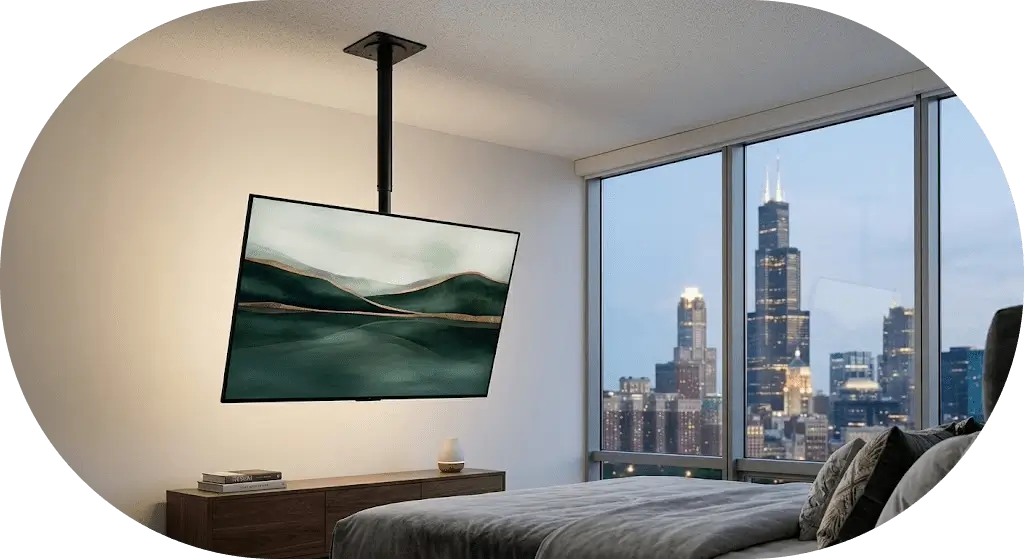
Ceiling mounting is not a universal choice. It is more complex, more expensive, and requires surgical precision in calculations. However, in the hands of a professional, this solution transforms into a technological masterpiece that saves an interior where other methods fail.