Mounting Giants: Safe Installation for Large-Scale TVs
Physics vs. Aesthetics: Size Matters
When we cross the 75-inch threshold and approach 100-inch panels, we move beyond “standard household mounting” and enter the realm of serious structural engineering. Modern giant panels create an illusion of lightness due to their minimal thickness, but this lightness is deceptive.
- Colossal Weight: An 85-inch TV can weigh between 100 and 140 lbs (45–65 kg), while 100-inch models, combined with a heavy-duty bracket, can easily exceed 175–200 lbs (80–90 kg). This is comparable to the weight of an adult hanging on your wall 24/7.
- Center of Gravity and Surface Area: The larger the screen area, the more complex its balance. Any accidental touch to the edge of such a panel creates a powerful torque that is transmitted directly to the mounting points.
- Handling Risks: A screen span of over two meters makes it vulnerable even to minor air currents or sudden movements during transit. A single improper grip can lead to micro-fractures in the matrix, which you might only notice after the power is turned on.
What You Need to Know About Brackets
VESA Specifications: Giants have mounting holes spaced at significant intervals (600×400, 800×600, or larger). The bracket must feature a wide wall plate to distribute the load across a large surface area of the wall.
- UL Certification and Steel: We select mounts manufactured from thick-gauge, cold-rolled steel. A UL certification guarantees that the bracket has been tested with a load four times its rated capacity.
- Locking Mechanisms: Professional models utilize additional steel latches or safety bolts that prevent the panel from accidentally sliding off the rails if bumped.
Mounting and the Unwavering “3-Stud Rule”
In Chicago, most residential buildings feature frame construction with studs spaced at 16 or 24 inches. While a typical bracket covers two studs, we apply a much stricter standard for 85″+ screens.
- Extended Base: We use brackets with wall plates ranging from 32 to 40 inches in length. This allows us to securely anchor into three vertical wood studs simultaneously. This redistributes the weight across three points rather than two, significantly reducing the stress on each individual part of the building’s frame.
- High-Caliber Bolts: Instead of standard screws, we use heavy-duty lag bolts that penetrate at least 3 inches into the solid wood.
- Brick and Concrete Installation: In Chicago’s historic buildings or industrial lofts, we often encounter masonry. In these cases, we utilize chemical anchors or steel expansion sleeves capable of withstanding vertical loads of several hundred pounds.
The Potential Dangers of Full-Motion Mechanisms
Many clients want the ability to swivel their 85-inch TV at will. This is a legitimate desire, but it requires 100% reliable structural preparation.
- The Geometry of Force: When you extend a 130 lb panel 28 inches out from the wall, the law of the lever comes into play. The load on the upper mounting bolts increases exponentially. This is no longer just downward weight — it is a force attempting to “rip” the mount out of the wall with the power of a mechanical jack.
- Minimizing Play: Only dual-arm steel mechanisms (Dual-Arm) can support such mass without tilting the horizon. We meticulously check every joint for play before final fixation.
Meticulous Teamwork
Installation at this level is never a solo job. It is always executed as a team (minimum of 2–3 specialists).
- Synchronized Movement: While two people hold the panel, the third controls the alignment with the bracket grooves and immediately engages the safety screws.
- Matrix Protection: Large screens are extremely sensitive to frame pressure. We use professional-grade suction cups or grip the TV strictly by the manufacturer’s designated technological zones to avoid damaging the backlight layers.
- Laser Control: On a seven-foot-wide screen, even a 1-millimeter deviation will stand out. We use high-end laser levels for flawless alignment.
Cable Management for Ultra-HD Systems
A large TV usually comes paired with high-end soundbars, gaming consoles, and media players.
- Concealed Routing: We organize in-wall cable routing in compliance with US fire safety standards (CL2/CL3 rated cables).
- Matrix Protection: Large screens are extremely sensitive to frame pressure. We use professional-grade suction cups or grip the TV strictly by the manufacturer’s designated technological zones to avoid damaging the backlight layers.
- Port Access: For these giants, it is critical to provide access to HDMI ports without dismantling the TV. We utilize 90-degree adapters or pull-out systems that allow for equipment maintenance.
Safety Above All Else
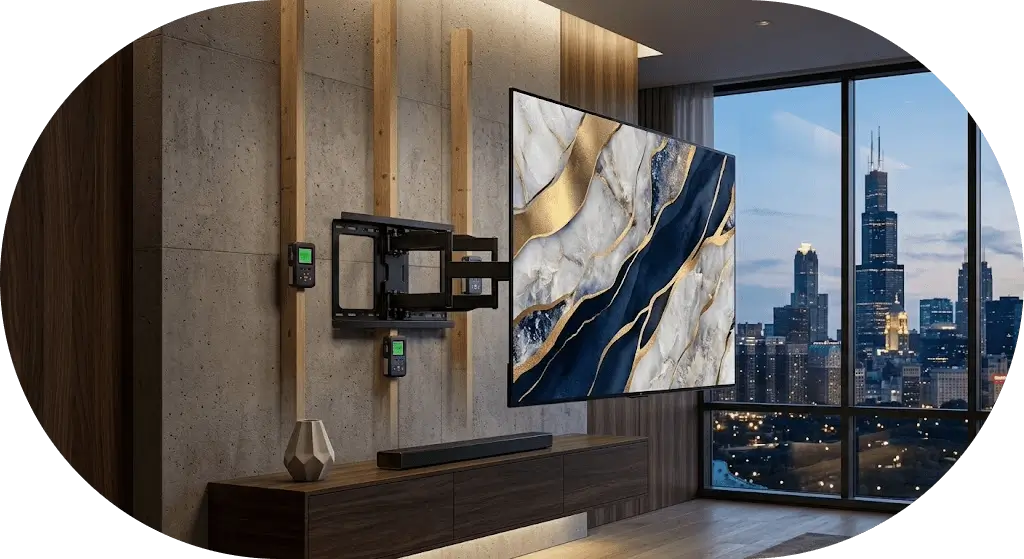
Installing a 75–100 inch television is not the place to look for a “budget handyman.” A mistake can cost not only the price of the TV itself (which can reach several thousand dollars) but also the safety of your home.
Professional installation is your guarantee that your home theater will delight you for years while remaining a rock-solid part of your interior. In Chicago, where quality and reliability are valued, we provide exactly this — an uncompromising approach to the safety of your technology.