Safety Guide for Corner TV Mounting: Aesthetics Meets Reliability
Why Corner Mounting is a Truly Beneficial Solution
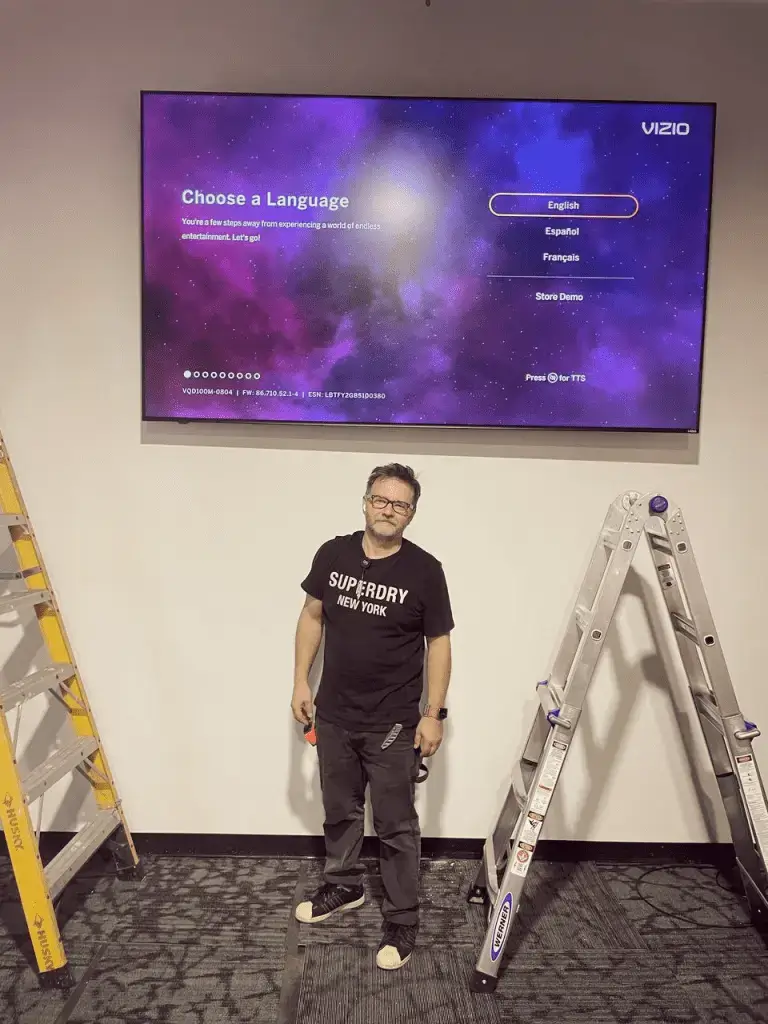
In modern Chicago interiors, where every square inch counts, corner TV placement has evolved from a “desperate measure” into a calculated design choice.
- Transforming “Dead Zones”: Corners in living rooms often remain underutilized, eventually becoming dust traps that look quite dull. Installing a TV in this area frees up primary wall space for vibrant accent decor or large mirrors that visually expand the room.
- Fighting Glare and “Light Attacks”: One of the main challenges in Chicago apartments with large panoramic windows is the excess of natural light. Corner mounting allows the screen to be positioned at a specific angle to completely eliminate reflections from the sun during the day or bright streetlights at night.
- Maintaining Dynamics in the Living Area: For open-space layouts, this is the perfect solution. A corner TV installation allows you to direct the screen simultaneously toward the sofa in the lounge area and toward the kitchen, making the space truly functional without cluttering it with extra furniture.
Corner Mounting vs. Traditional TV Stands: Why the Former Wins
Buying a standard wooden stand and placing a TV on it seems simple and straightforward — so why overcomplicate things? Below are the objective advantages of corner mounting that make it a superior choice.
- Visual Lightness: A device attached to the wall creates a “floating” effect. It doesn’t overload the space or draw too much attention to itself. Even a neat stand makes a room feel tighter. From an aesthetic standpoint, it’s better to bypass additional furniture.
- The Safety Question: If there are small children or pets in the family (especially large dogs), a TV stand is always a risk factor. If a fragile device accidentally falls, it usually results in an expensive repair or a total replacement. If your home is full of life, risking expensive tech isn’t worth it. Wall mounting with secure fixation makes a fall physically impossible.
- Eye Comfort: With wall mounting, professionals adjust the height of the bracket to match your height and the distance to the sofa. This prevents neck, back, and eye strain during long hours of watching your favorite movies and shows.
Choosing the Equipment: Corner-Specific Brackets vs. Long-Arm Models
When it comes to corners, a standard flat mount is useless. An engineering approach is required here.
- Corner-Specific Mounts: These models are mounted directly at the junction of the walls. They consist of two wall plates attached to two perpendicular planes. This creates an incredibly strong structure — the so-called “bridge effect.” If your panels are heavy (weighing over 110 lbs / 50 kg), this option is the optimal choice.
- Long-Arm Mounts: A favorite among many of our clients. The extension plate in these models can reach up to 40 inches. These models are incredibly flexible; the base can be anchored to a flat wall near the corner, while the TV is extended so that it appears to be installed exactly in the center of the corner. It’s a clever optical illusion. As a bonus, you get easy access to the back panel for connecting additional cables or gaming consoles.
Geometric Miscalculations: Why Diagonal Dictates the Rules
A 65-inch TV won’t work with just any bracket. This is where high school geometry comes into play. The width of the TV chassis is a key parameter. If the bracket’s extension is shorter than half the width of your TV, the panel simply won’t turn to the desired angle — the edges of the device will hit the wall.
Our Preparation Protocol:
- Precise Measurement: We account for the diagonal and the thickness of the bezel.
- Radius Check: It’s also crucial to calculate the rotation arc so the TV doesn’t hit curtains or decor on adjacent walls.
- Safety Margin: The model is selected with a weight capacity margin of at least 1.5 times, as the leverage pressure on the wall increases manifold at maximum extension.
Technical Foundation: Prioritizing Wood Studs Only
In Chicago, we work with a variety of building types — from historic brick structures to modern skyscrapers.
- The Golden Rule of Frame Houses: We use magnetic and ultrasonic scanners to find the “golden section” — the studs. The structural frame of the building must bear all the primary weight.
- Why Drywall is Taboo: Using drywall for mounts that require strength is a “time bomb.” Even if it seems secure at first, vibrations and weight will loosen the fasteners over time, leading to wall degradation. We never take such risks.
- Brick and Concrete Features: In homes with loft interiors, we use specialized steel anchors that expand inside the material, ensuring a “death grip” on the masonry.
The Secret of Invisibility: Cable Management in the Corner
Corner installation is tricky because turning the screen often reveals the back of the TV and a nest of wires. However, these issues can be solved professionally.
- In-Wall Routing: If the wall’s construction allows, we route all cables (power, HDMI, optical) inside. All kits undergo preliminary checks according to generally accepted fire safety standards.
- Professional Cable Channels: If the property is a rental and touching the walls is highly discouraged, we install neat conduits. We paint them to match your walls, turning a potential nuisance into a nearly invisible element of the finish.
FAQ: Frequently Asked Questions About Corner Mounting
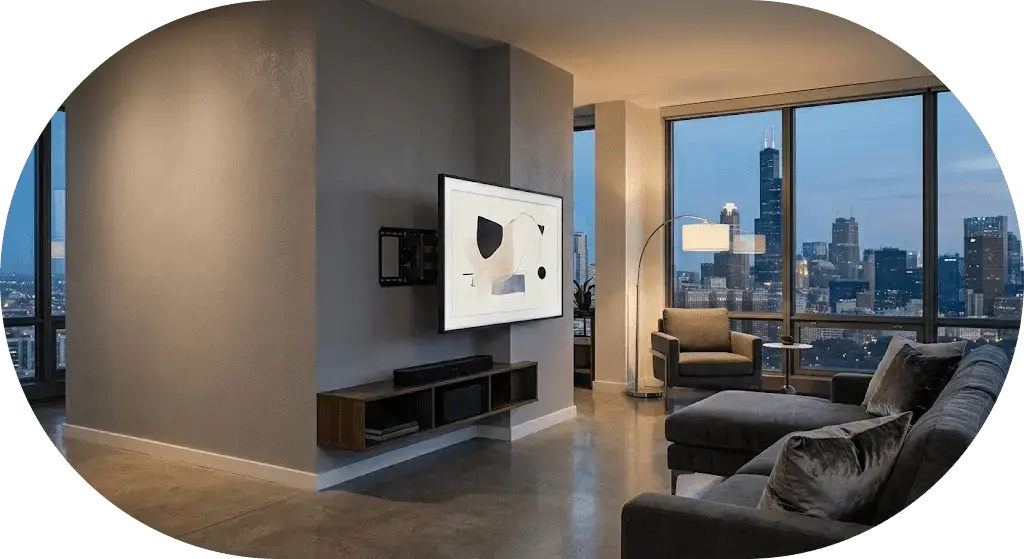
- Can a Samsung Frame TV be hung in a corner? Yes, but the “art” magic works best when it’s flush against the wall. For corners, we use special ultra-thin brackets that minimize the gap.
- Will this damage the wall? If the work is done correctly according to all standards, the wall will not be damaged. The load is distributed vertically along the frame.
- How long does installation take? Corner installation is more complex than standard mounting; it usually takes about 2 hours, including cable setup.