TV in a Niche: Beautiful Aesthetics, But How Practical Is It?
Why Hide a TV in a Niche?
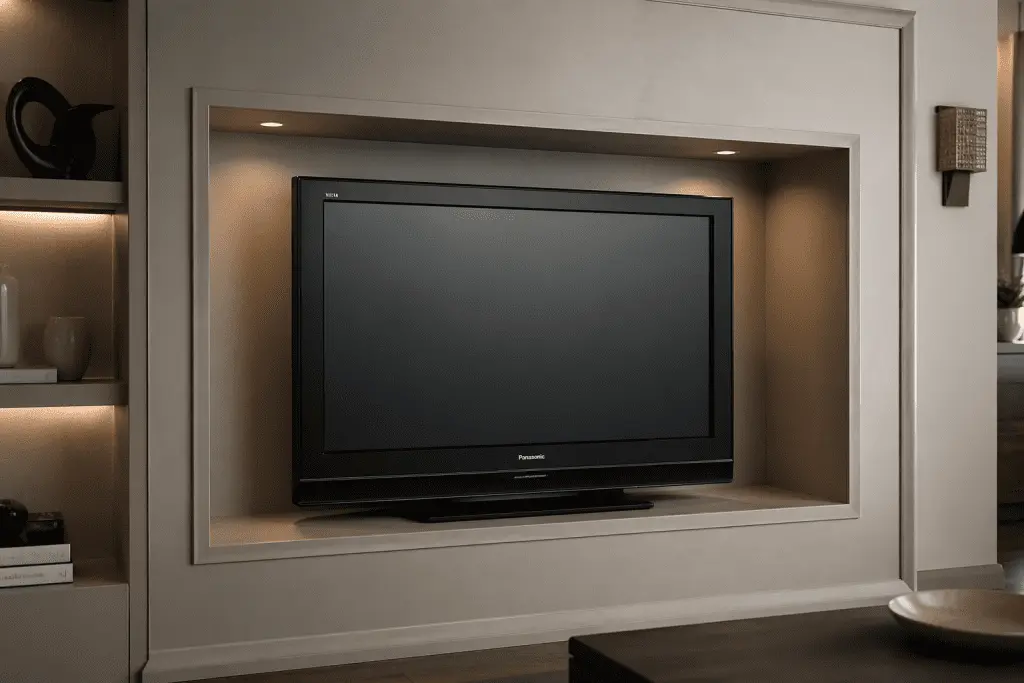
Modern interior design, especially the sought-after styles in the Chicago area, leans toward minimalism and even a certain asceticism. This trend has revived the demand for architectural niches for electronic devices. Installing a TV in a pre-prepared recess is not just a designer’s whim, but an effective solution for both purely aesthetic and functional tasks.
What makes niches so great? ⬇️
- A Clean and Polished Look: A niche hides the TV’s chassis, aligning the screen flush with the wall. This creates the effect of a painting or even a window into a digital world. Your gaze doesn’t get caught on wires, brackets, or side panels — nothing distracts you, making it much easier to focus on your favorite film. The room as a whole looks significantly more organized.
- Space Optimization: In narrow rooms, a TV protruding 4–6 inches can obstruct natural movement. A niche solves this by “integrating” the device directly into the wall.
- Ultimate Protection: A niche shields the fragile device from accidental bumps during active movement — whether it’s children playing, a party, or any other household activity. It’s simply convenient.
Critical Nuances to Consider Before Building the Niche
This is the most crucial stage, where 90% of mistakes happen. Clients often build the niche first and buy the TV later, or they make the niche “flush” with the TV’s dimensions. Our main advice: select your TV model first, then build the niche around it.
- Clearance Requirements: The niche must be larger than the TV. We recommend leaving at least 2–3 inches (5–7 cm) of free space on every side (top, bottom, left, and right).
- Why is this necessary? First, for the installer’s hands to mount the TV onto the bracket. Second, for access to connection ports. Third — and most importantly — forventilation.
- The Critical Importance of Airflow:Modern 4K and 8K panels, especially OLED and QLED models, generate significant heat. Trapping them in a tight niche without airflow will cause rapid overheating. This leads to:
Reduced brightness and image quality.
- Screen defects and artifacts.
- A significantly shorter lifespan for expensive equipment or total failure.
- In extreme cases, the risk of dust ignition inside the niche.
The Solution: The extra space around the TV ensures natural convection (warm air rises and exits through the top, while cool air is drawn in from the bottom). For deep or very tight niches, we recommend installing active fan-based cooling systems.
Niche-Specific Brackets
- Fixed Mounts: These are ideal if the niche is shallow (barely deeper than the TV) and you want to achieve the maximum “picture frame” effect. The TV hangs parallel to the wall with minimal gap.
The Downside: This is the most difficult option for cable management and maintenance. You will have to completely remove the TV just to add a new HDMI cable for a console.
- Full-Motion (Articulating) Brackets: These might seem like a contradictory choice for a niche, but they are actually a very sound decision. The bracket allows you to pull the TV out of the niche, turn it for easy cable access, wipe away dust, and then neatly tuck it back in.
Important: Niches require specific bracket models that fold very compactly so the TV doesn’t protrude past the wall surface.
Let’s Talk “Guts”: Cables and Outlets
A niche is a closed system, so you must plan ahead for how you will access it. Key considerations include:
- Outlet Placement: Power and Ethernet outlets must be located inside the niche but positioned so they don’t prevent the bracket from folding completely. We usually place them in a bottom corner or in a recessed area behind the center of the TV.
- Cable Management: All wires must be laid out so that when the bracket moves, they aren’t stretched or kinked. Use cable ties and leave a small “loop” of extra length.
- Maintenance: Remember that you may eventually need to update firmware via USB, connect a new gaming console, or restart an Apple TV hidden in the niche. Ensure you have access to these ports without dismantling the entire wall. For premium TVs, we recommend using external connection hubs (like the Samsung One Connect Box), which can be placed in a nearby accessible cabinet.
YES to Wood Studs, NO to Drywall
As with corner mounting, we must address the structural integrity of the wall. Most homes in Chicago feature a frame construction.
- Why Drywall is a Major Negative: This material is not load-bearing — it is fragile and not designed to hold the weight of a TV plus a heavy-duty bracket. A bracket attached only to drywall (even with high-end anchors) will eventually tear out a piece of the wall.
- The Golden Rule of Framing: We use high-precision scanners to find the center of the wood studs.The bracket must be secured with heavy-duty lag bolts directly into the wood. This is the only guarantee that your 75-inch screen won’t end up on the floor.
- Niches in Drywall Partitions:If you are building a drywall niche specifically for a TV, we strongly recommend reinforcing the back wall with a sheet of plywoodattached to the studs. This allows the bracket to be mounted anywhere on the plywood surface.
Conclusion: A Niche is Beautiful, but it Requires Precise Calculation
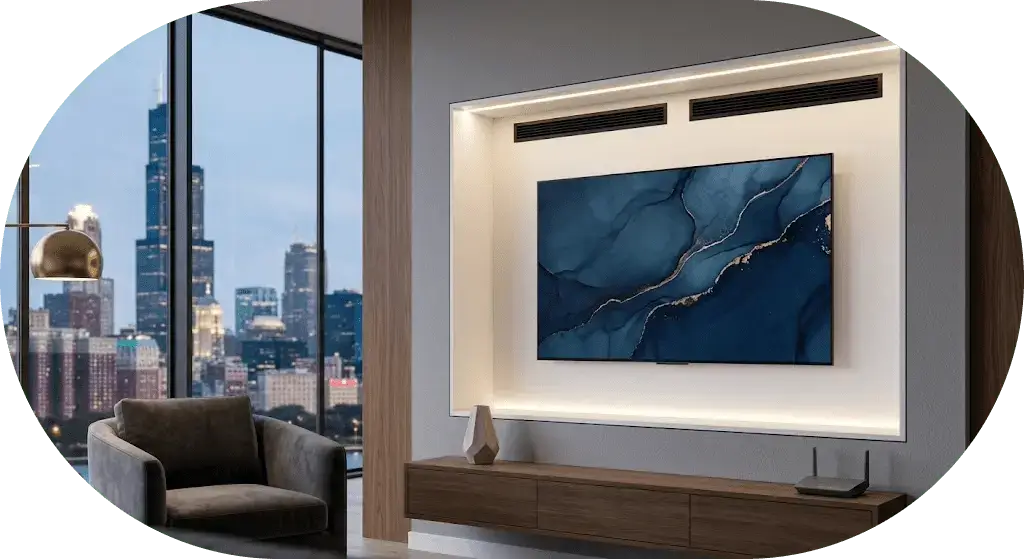
Installing a TV in a niche is a fantastic solution that makes an interior look visually more expensive. However, this solution does not forgive spontaneity. A calculation error of even a couple of inches can result in the TV not fitting or burning out from overheating within a month.
Professional installation ensures all parameters are considered — from wall type and the thermal output of your TV to the specific geometry of the bracket. It is an investment not only in the longevity of your equipment but also in your peace of mind.