Why Standard Mounts Are a Risk: A Professional’s Perspective
When we first visit a client’s home for an initial audit, the first thing I look at is how their current equipment is mounted. In about eight out of ten cases, I see a standard, off-the-shelf bracket from a nearby big-box store that is holding on by a thread. Yes, for a 40-inch television, that might be acceptable, but larger, heavier devices do not forgive such oversights. In the end, penny-pinching ends up costing twice as much: if a flimsy mount fails to support the weight of the device, the entire assembly comes crashing down, damaging not just the equipment, but the interior as well.
Mass-Market Illusions: The Power of Clever Marketing
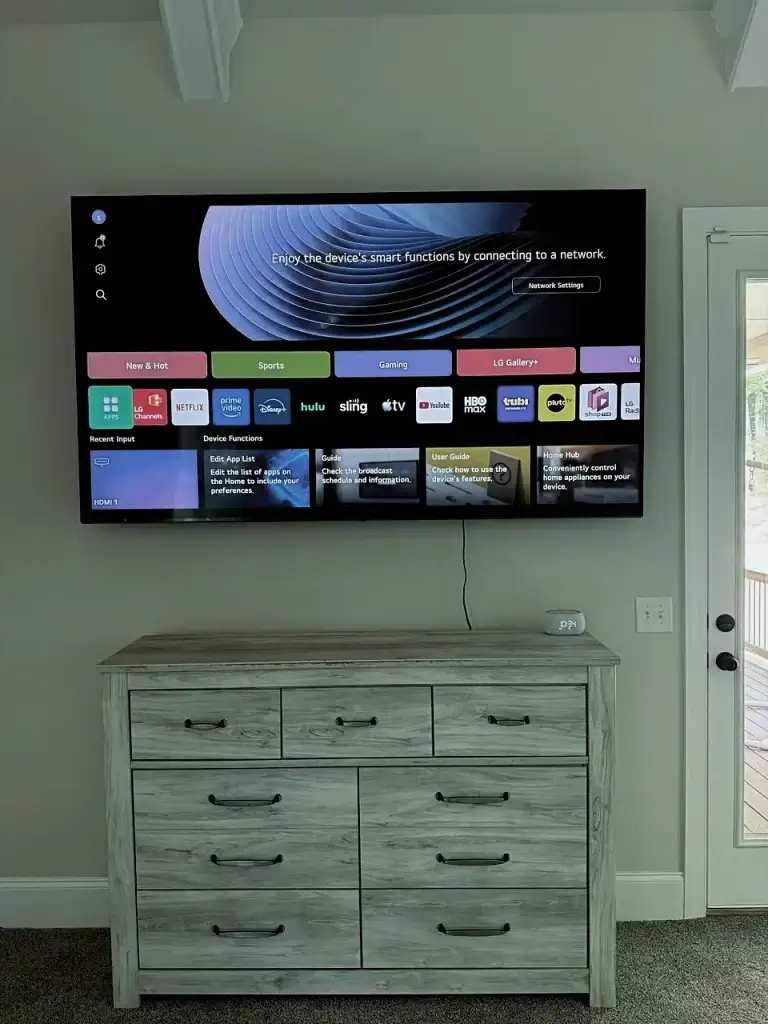
The main problem with “standard” solutions lies in their universal nature. Manufacturers try to make them suitable “for everything” — from lightweight plastic monitors to heavy, modern OLED panels. However, the laws of physics do not tolerate generalizations. A standard mount is designed with the bare minimum safety margin, and in most cases, it fails to account for the dynamic loads that occur in real-world living conditions.
When we mount a panel, we don’t just treat it as a static object. We calculate the system as a precise engineering node:
- Load Leverage. Articulating swivel mounts are subjected to immense stress when extended. Budget alloys and thin hinges simply cannot withstand this force over time, which leads to the screen gradually sagging.
- Alloy Quality. Standard mounts are often made of thin-walled steel of questionable origin. Over time, the metal begins to fatigue. Micro-cracks form in the stress points, invisible to the eye, until the bracket eventually deforms under the weight of the screen.
- Anchoring. The wall plugs and screws included in these kits are a gamble. They are not designed to work with historic brickwork, porous stone, or the specific wall materials we encounter on our projects. We prefer professional-grade anchoring systems, selected individually based on the integrity of the base material.
Why Custom Solutions Are a Necessity, Not a Luxury
Our approach is simple: a mount should be invisible, reliable, and eternal. When we design a mounting system, we stop calling it a bracket. In our lexicon, it is a load-bearing frame. Unlike standard solutions, we use powder-coated hardened steel, which eliminates corrosion and deformation for decades. This is equipment that will outlive the TV itself, and perhaps more than one.
We focus on custom integration because it gives us a level of freedom unavailable with off-the-shelf products:
- Micro-Adjustments. Our frames allow us to align the screen with millimeter precision in three planes even after it is hanging on the wall. This is critical for achieving a seamless look where the panel sits perfectly flush with cabinetry or a custom niche.
- Cable Integration. In our designs, we incorporate hidden cable channels and dedicated mounting plates for media players, power bricks, and Apple TV systems directly behind the panel. This eliminates the visual noise of tangled wires.
- Vibration Protection. In historic homes, vibration is a constant companion, caused by everything from city traffic to powerful audio systems within the room. The rigid connection to the wall, coupled with the specialized damping gaskets we provide, completely neutralizes these resonances, protecting the delicate matrix from micro-vibrations.
The Cost of the Solution vs. The Cost of Failure
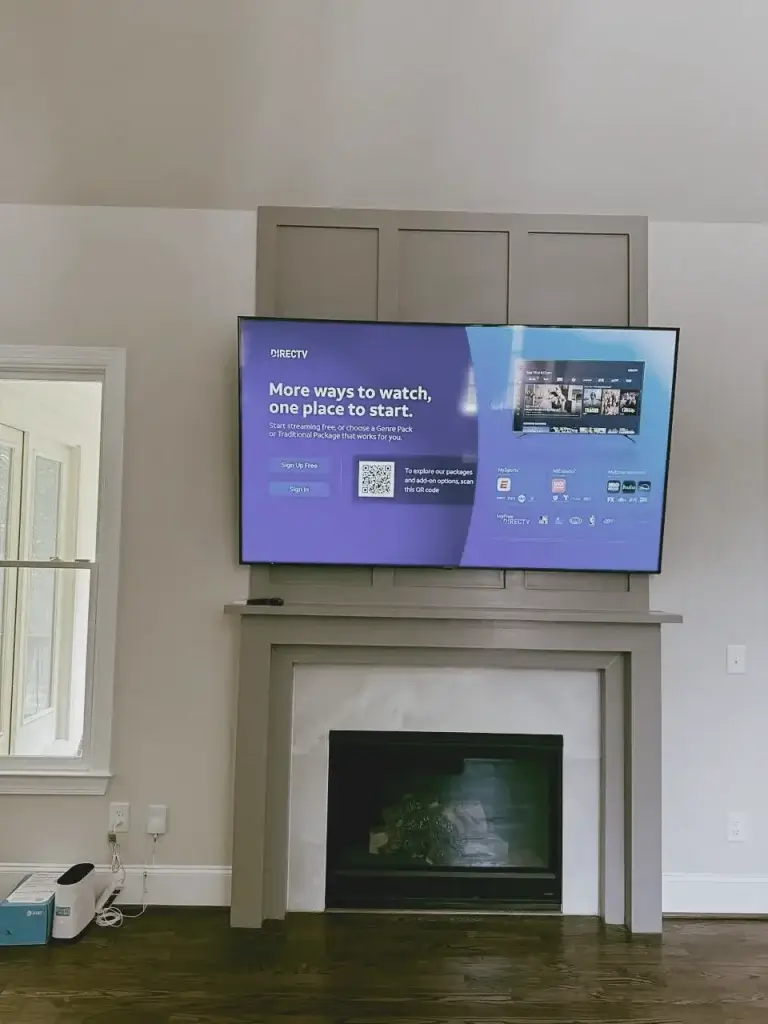
’m often asked: “Why pay more for a custom construction if the internet is full of brackets with good reviews?” My answer is always the same: you aren’t paying for a piece of metal; you’re paying to avoid a “catastrophic scenario.”
Imagine what happens if a 98-inch panel rips off the wall in a living room where a child is playing or where valuable antique furniture is placed. A standard bracket provides no guarantees; it only offers hope. A professional solution is a mathematically calculated load, where every node is stress-tested in conditions as close to the real world as possible. We work so that the client never has to think about the reliability of the system. Technology should be a silent, flawless service that is part of the interior, not a source of anxiety. If we take on a project, we eliminate the factor of chance during the hardware selection phase. Because, in the end, the quality of our work is measured by how long and how reliably everything functions long after we’ve left the site.